Yaesu FT-5DR -- Compact HAM Handheld
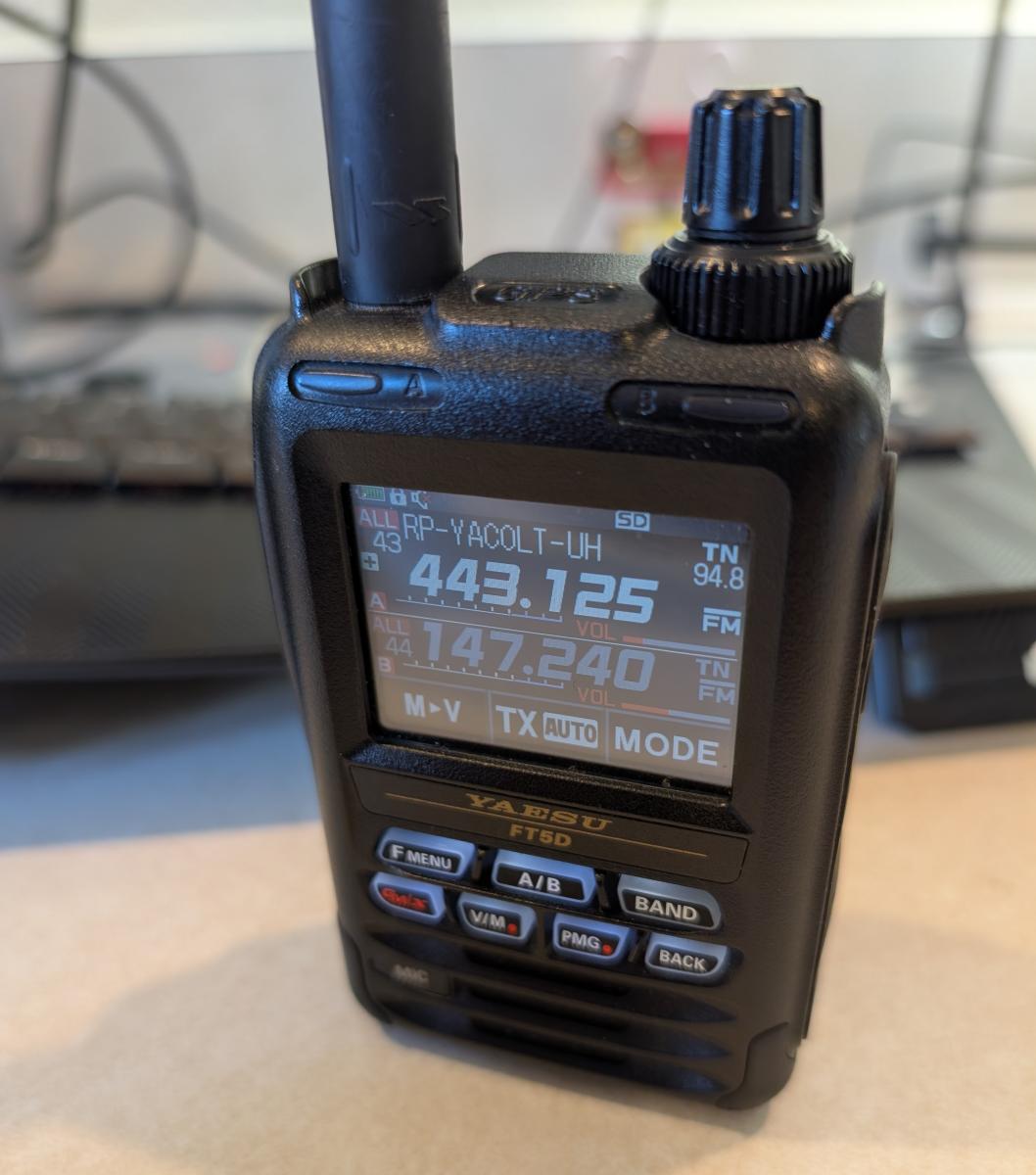
- Buy it on Amazon - $495
- Buy it on Gigaparts - $419 (recommended, plus you can get it mars modded without voiding factory warranty)
- YAESU SSM-17A external mic - $32 (an absolute bargain with exceptional quality)
Everyone's requirements for a good handheld radio are different. Light, compact, powerful, durable, waterproof, GMRS capable*... there's a wide variety of other requirements that folks may cook up. For me, a good handheld radio needs to be compact, durable, and ideally have some waterproofing, if not be outright submersible as a product. I also need the interface to be intuitive and easy enough to work with on the fly with dual monitor.
Enter the Yaesu FT5D. This phone sits on the reasonable side of "compact", and yet it didn't trade size for ease of use as it features a large touchscreen display. The Yeasu FT5D is also IPX-7 rated so it's impact and submersion rated. This ticks a lot of the right boxes for me, including it's reasonable sized screen and dual monitor capabilities. Given all these details, I was intrigued. The price however, is NOT cheap... but when I found a lightly used model local to me, I knew I had to grab it to try it out!
Pros & Cons
So I'll keep this review simple by just going straight to the pros and cons of this particular handheld.
Pros / What I Like About This Radio
The most compact and capable HAM radio that is IPX7 rated. I've looked around and there really just aren't many robust options that are submersion rated, and what there are for options are either notably larger OR notably dated in their UI. The Yaesu FT-5DR is the current industry leader for the combination of submersion rated along with capable and easy to use. yes, the VX-6R is supposedly a more robust radio, but the dated display and UI that wasn't even that nice when it came out 20 years ago... that's not for me... yet!
MARS mod-able / GMRS capable*. This one always gets foagies up in arms about why not just buy another radio or "that's illegal!"... but many folks find value in having the capability. So just like the majority of people don't actually tow with their trucks but want the capability... some folks never intend to use these radios outside intended frequencies, but for those "what if" situations they want the ability.
Large easy to read display with a reasonable user interface. For me as a relatively new Ham with a billion other hobbies, I need a lot of helping information on my radio display. Showing me just the frequency isn't going to work, as I doubt I will ever memorize all of the 15 different ham repeaters in my suburb of PDX area. Multiply that by the 3 repeaters I want to reach on Mt Hood, the 5 I want to try and ping on my way to work, and the various repeaters that I may be able to reach from all of my various whitewater kayak destinations.... just frequency or short channel names isn't going to fly.
The Yaesu FT-5DR not only has lengthy channel names, but it displays the channel name and the frequency. This will honestly aid me in learning and remembering frequencies, especially compared to my other radios like the Baofeng UV-5R mini, which just displays the channel name.
Lots of little quality of life items. The squelch buttons on the side are excellent both to quickly check if a channel is clear and to adjust the per channel squelch settings. Add in the easy PTT and easy to work with buttons... I'm pretty happy with this puppy!
Automatic Digital Tx. So there's a lot to know about digital signal and various models and standards... which can be multiplied by having to know which repeaters do or do not allow digital. The Yaesu FT-5DR however has an automatic mode where it can detect for you if it can use digital with a given repeater and it seamlessly navigates the process for you which is pretty rad!
APRS and GPS. Conceptually APRS (automatic packet reporting system) is a great back country tool. It'll report where you are at set intervals, and digipeaters in the area will pick up your transmission and log it. In theory this would be a great way to help get located in the event you go lost or are injured or some other situation necessitating back tracking your locaiton. Unfortunately... these are only as useful as the presence of repeaters in the region with this functionality, of which there aren't so many when it comes to really remote locations... which is precisely where you'd want this sort of thing. So suffice it to say, a cool concept, but in practice it's perhaps more of a battery drain than anything.
Things I don't Like About This Radio
The Stacked Knobs. Having the volume/freq knob right ontop of each other sure was convenient I'm sure to keep the radio simple... but it's a user experience headache. While you can assign the knobs differently, both have their draw back. With volume on the bottom knob and frequency on top you can't adjust volume without also changing your frequency or channel. With the inverse of this, you can't go up 4-5 channels without turning your volume all the way up to the max. Would it be so hard to disable the upper knob while the lower knob is being turned? Maybe there's a setting here, but both myself and AI can't figure it out.
Can't adjust both volumes with the radio locked. When I use this radio for adventures I generally have my group on simplex on B, and a local repaeter I want to make contacts with on A. I will have my radio locked on my simplex B and in my holster. I'll primarily use the external mic to talk to my group, but if I hear a contact on the repeater I have on A I'll generally pull out my radio, swap to A and make contact. Sometimes though, I'll be in close proximity to my group and chatting normally, and somebody will jump on the repeater on A. I want to turn my volume down so I can chat with my group... and I can't without taking my radio all the way out and switching channels and then adjusting the volume down... all to just redo it again afterwards to put the radio away. It's a lot of pointless steps for what could be a simple menu setting of "channel volumes linked".
Not USB-C Chargeable. Let's say the shoot does hit the fan and you find yourself without power, possibly without access to your home, or you're out trying to help folks during an emergency. As with all things with a battery, eventually that battery can go low... so what are you to do to charge your radio? You'll be able to find buckets of USB-C charging capabilities and so with a USB-C compatible phone you'll have no problems.. but unless you have the specific charger for the Yaesu FT5-DR around, you're screwed. Considering this is supposed to be a pretty robust radio ready to go for SHTF... not being flexible for charging is a major oversight. Think of it like having a rifle with the most obscure ammo possible... if things hit the fan and you need to reload, can you get ammo? Does that make it an ideal choice then for worst case scenario? No, no it doesn't.
Not CHIRP Compatible, Yet. I really dig CHIRP. Not just because it's free, but because it works accross so many different devices and I can easily copy frequencies between radios and keep them all in sync. Currently I have to copy and paste per cell to move between my Yeasu and my Baofengs. I'd really like to not have to deal with that!
Battery Size Seems Excessive. A lot of folks complain the battery runs out fast if you're using APRS and GPS and all the other fancy digital functionality all at once. With it off, you get decent bit of time however. Personally though for adventures I'd really like a thin battery option. While battery life may only be 4 hours or so of active life... for me going on a short adventure might mean wanting the most compact radio possible, so a flush and small battery on the back of the unit would reduce the thickness a solid 15% and further push this radios dominance in the compact radio category.
Battery Life truly is meh. I took my radio up the mountain and my wife had her UV-5R mini. By the end of the day my FT-5DR battery was toast despite only being on and doing a few transmissions to repeaters for maybe a combined hour of on time and 10 minutes of transmit. The UV-5R mini was still showing full bars and could easily go another two days of that activity level. GPS was off, and I believe APRS was off... but there sure are a lot of menus relating to this.
RT Systems Compatible, but it's not As Good as CHIRP. Honestly, CHIRP is superior in my experience. You can adjust radio settings in CHIRP but not RT. RT also for mac did the most painful muck up of making it so CMD+Z doesn't undo... it clears the entire line. This double screws mac users because not only did you fail to undo what you were up to, but you now deleted the entire line and lost everything you'd been working on... and you can't undo that mistake either. I put in a ticket to fix this issue, we'll see if they address it.
How The Yaesu FT-5DR Faired in the Wild
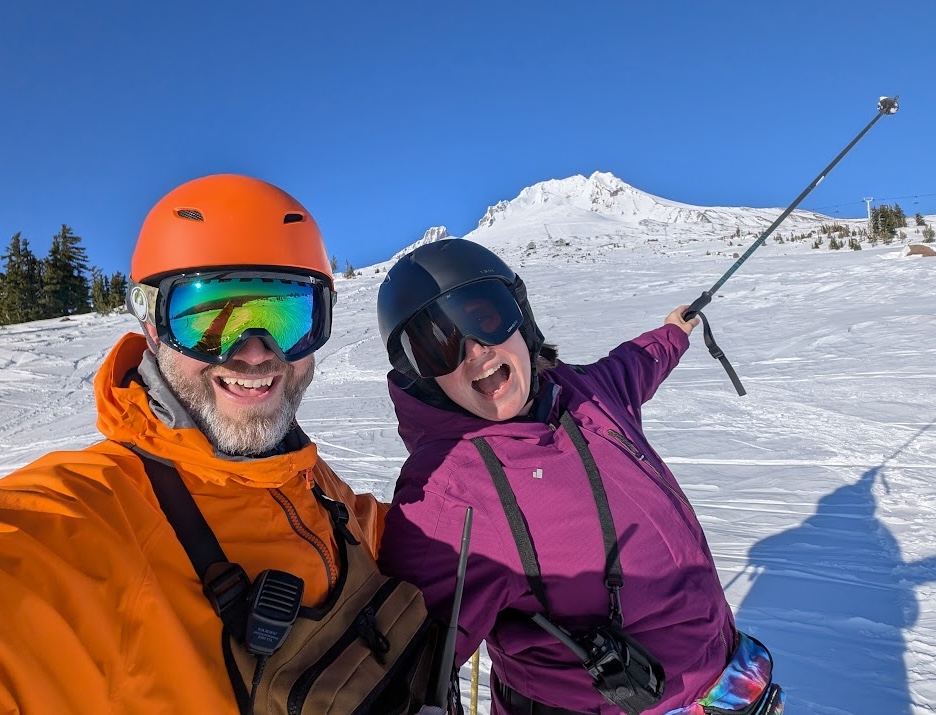
So my Yaesu FT-5DR was definitely purpose acquired for using while skiing. While I definitely fart around with it for local nets and while driving... I mostly like getting up on the mountain and being able to hilltop a bunch of far away repeaters. I even designed a custom holster for my radio so I can take it skiing, and if you want to know more aobut the holster it's in a section of this article below here! How did the radio actual fair in practice though?
First off, I got the YAESU SSM-17A external mic for use with my Yaesu FT-5DR radio, and the external mic is excellent. While I can't compare it to much else as I've mostly used Baofeng cheap mics... this one is loud, clear and the TX quality is exceptional. It's also easy to operate and work with even when gloved... so I have to give Yeasu credit where credit is due, they made this mic exceptional.
The TX quality of this radio with the mic was great and simplex between myself and my wife was exceptional. My wifes radio picked me up incredibly well with exceptional clarity. My wife's transmit clarity on her UV-5R was also exceptional... which makes me think the UV-5R minis aren't actually all that bad so much as their speakers and external mics are lacking... but with this external mic being 3x the price of the Baofeng external mic, AND the UV-5R mini being a 20x cheaper radio... UV-5R mini remains a budget brawler!
I was also able to reach a bunch of repeaters, many quite far away on other hilltops. I also got a few loud and clear copies on contacts so I gotta give the Yeasu points there. Given I was on a volcano at 6500 or so of elevation is pretty reasonable.
As for operating erverything, the radio was pretty straight forward. I had all my cheannels and repeaters programmed, I could easily hop between channels. Life was good. I do wish I could still operate the volume knob with the radio locked... I'd like to just lock the display. Twice I'd have folks jump on the repater to chatter while I was in the lift line talking to a friend. Fortunately a glove over the external mic speaker damped everything right down.
Battery wise... consumption was staggering. By the time I wrapped up skiing my battery was pretty much toast, showing one bar. I had to turn the radio off in the car until just before joining my local traffic net to check in... in which they never quite copy my callsign right despite me nailing the NATO phoentic alphabet. My Wife's UV-5R mini was on and we were simplexing the entire time... and still had full power. The UV-5R mini is a hard to beat radio, and if it were waterproof/submersible I'd never buy another radio.
Custom Molle Compatible Radio Holster / Pouch
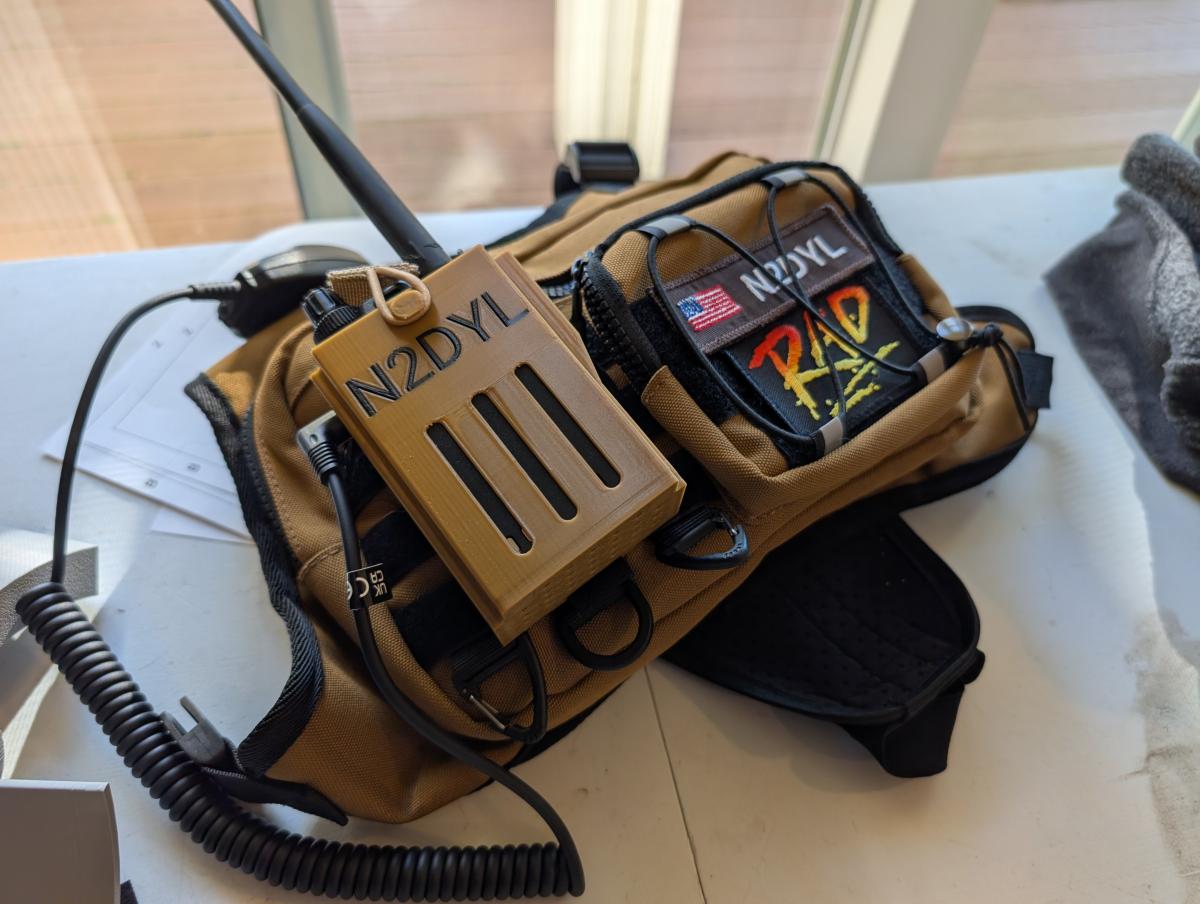
Interested in a customized and/or personalized Yaesu FT-5DR radio holster? Reach out to me with an email
A good handheld radio needs a place to live when you're mobile where it's accessible when you need it but leaves your hands free to do whatever it is that has you mobile in the first place. For driving a cupholder will suffice, but when you're outdoors and active something a bit more serious is needed. For me, I take my Yaesu FT-5DR radio with me skiing in my chest bag where I also come some first aid supplies and an avalanche beacon. While I'm skiing the radio is exposed to all sorts of movement, and if I crash I really don't want to wonder where my radio went. Looking online there were no legitimate holster options for the UV-5R... so It was time to combine my hobbies of CAD and 3d Printing with my Ham hobby!
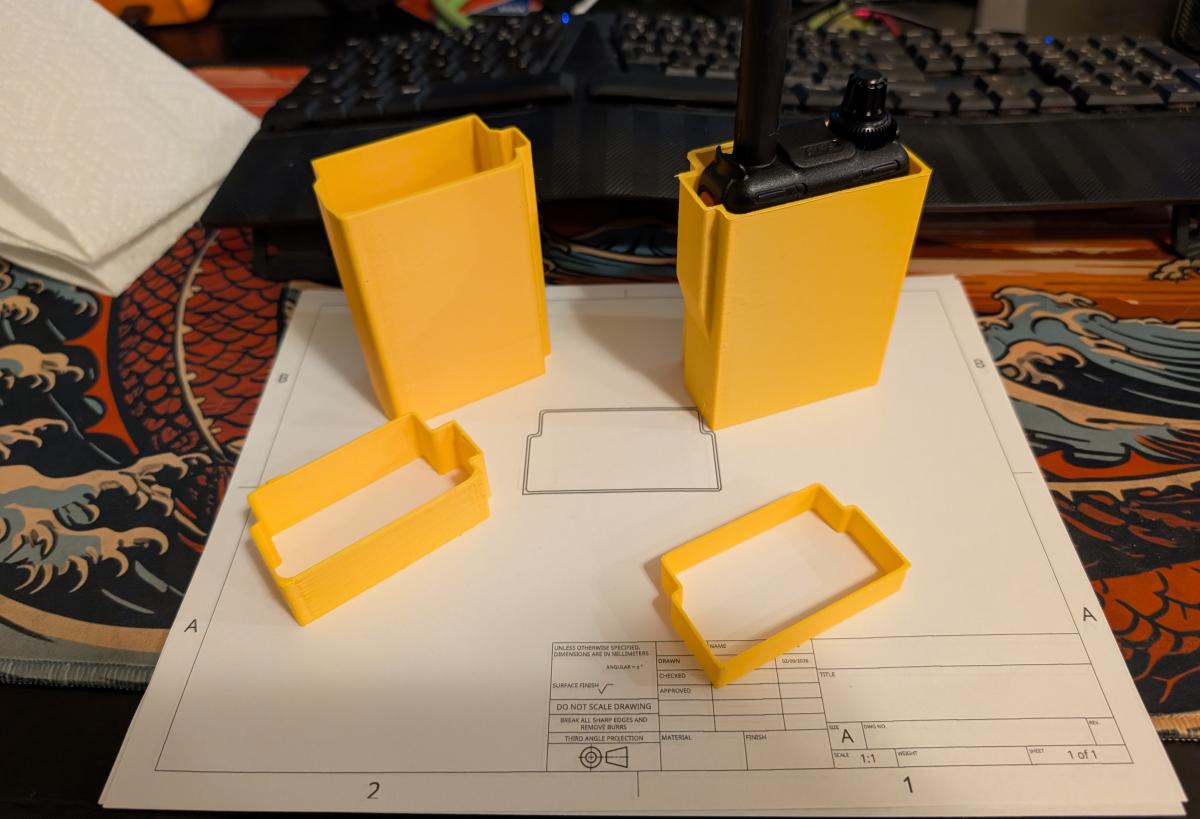
So unfortunately for me, I don't currently own a 3D scanner. So I began by taking a ton of measurements, and then plugging them into OnShape. One fun thing I've learned to do with my 3D printing is to slice my models early and often and print quickly on my Bambu Labs P1S so as I can verify measurements and things are both as I measured and as I thought. It's really easy to get too carried away early in the process and create a nightmare for yourself later on when some simply piece from early in the process was actually incorrect.
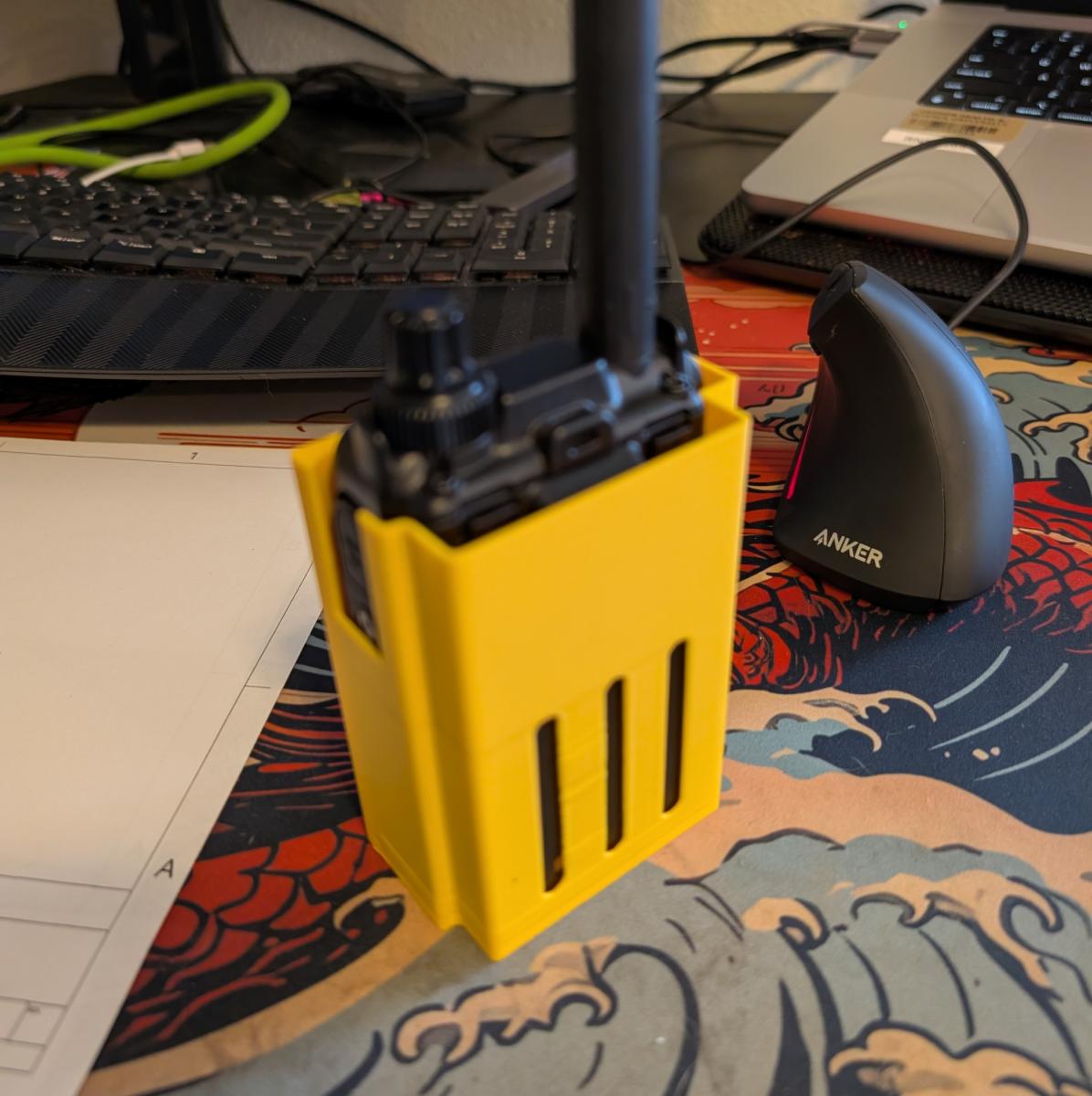
With the general shape designed with relief for the PTT, I added a few minor design elements to increase reliability of my setup. I added a cut out to allow for attaching an external mic, I added vents to the "front" of my design (which is actually the back of the radio) to allow venting, and I added holes to the bottom of the design to allow for drainage should water get into the case. I also added some not pictured elements like tabs for attaching elastic paracord to secure the radio from accidentally coming out in the event I am "flying inverted" aka eating it.
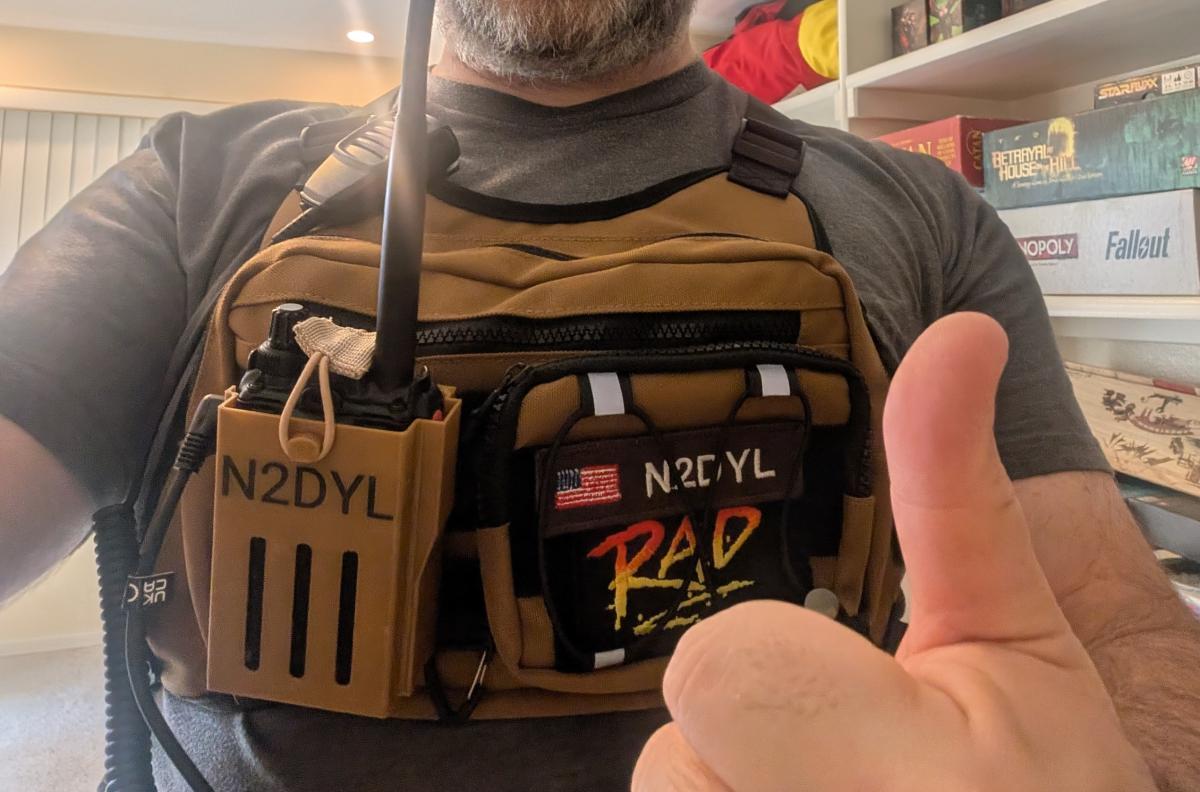
All of the design elements combined... allowed me to attach my radio holster to my chest harness. Not too shabby right!
Interested in one for yourself? Reach out to me with an email and I can 3D print you one with your call sign on it like I've done here. I can also set yours up for Molle or belt loops or whatever configuration you would find the most useful.